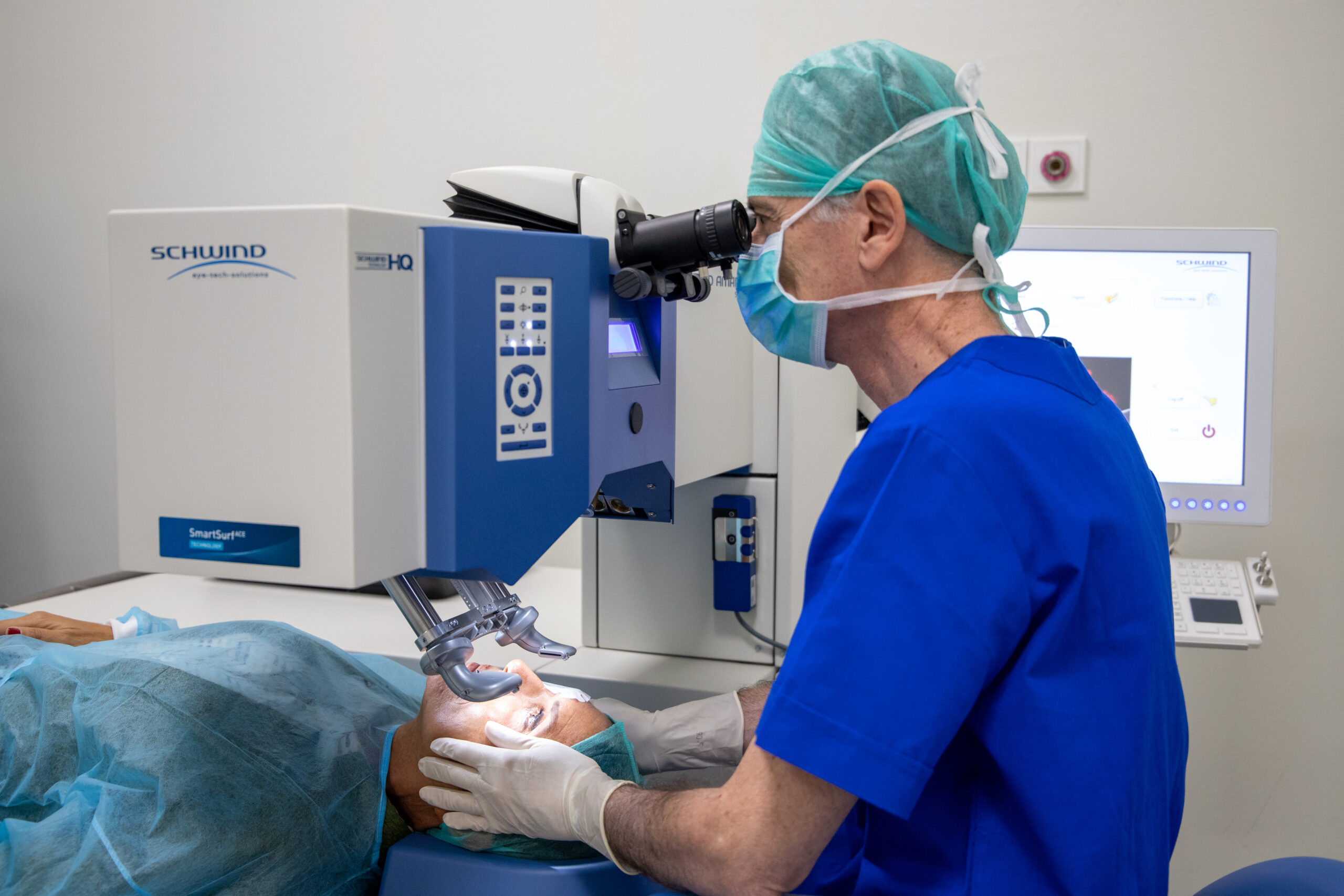
Excimer laser for vision defects
Laser treatments
Excimer laser for vision defects
Mild or moderate refractive errors (myopia, hyperopia, and astigmatism) can be treated with laser therapy, which often eliminate permanently the need for glasses or contact lenses.
There are four laser procedures: PRK (introduced in 1983), LASIK (1994), SMILE (2011), and TRANS-PRK (2013). All four procedures provide excellent and comparable visual results around one month after surgery.
Trans-PRK is the newest technique and the one used in our clinic. It works by modifying the curvature of the cornea, allowing light rays to focus on the retina. Of all the above mentioned techniques, it is the only one that uses a single type of laser for the entire procedure and does not involve cutting the cornea.
Compared to the other techniques, especially LASIK, it has four advantages:
1. it does not cut the cornea, thus eliminating the risk of losing the corneal flap due to possible subsequent trauma;
2. the risk of corneal deformation (ectasia) over time is minimal compared to other techniques;
3. unlike other techniques, it can be performed on relatively thin corneas;
4. it does not damage the corneal nerve plexuses and therefore tends not to cause dry eye symptoms, which occur in LASIK in more than 10% of cases.
However, not all eyes are suitable for refractive laser treatment; a preliminary examination is necessary to evaluate each patient’s situation.
There are four laser procedures: PRK (introduced in 1983), LASIK (1994), SMILE (2011), and TRANS-PRK (2013). All four procedures provide excellent and comparable visual results around one month after surgery.
Trans-PRK is the newest technique and the one used in our clinic. It works by modifying the curvature of the cornea, allowing light rays to focus on the retina. Of all the above mentioned techniques, it is the only one that uses a single type of laser for the entire procedure and does not involve cutting the cornea.
Compared to the other techniques, especially LASIK, it has four advantages:
1. it does not cut the cornea, thus eliminating the risk of losing the corneal flap due to possible subsequent trauma;
2. the risk of corneal deformation (ectasia) over time is minimal compared to other techniques;
3. unlike other techniques, it can be performed on relatively thin corneas;
4. it does not damage the corneal nerve plexuses and therefore tends not to cause dry eye symptoms, which occur in LASIK in more than 10% of cases.
However, not all eyes are suitable for refractive laser treatment; a preliminary examination is necessary to evaluate each patient’s situation.